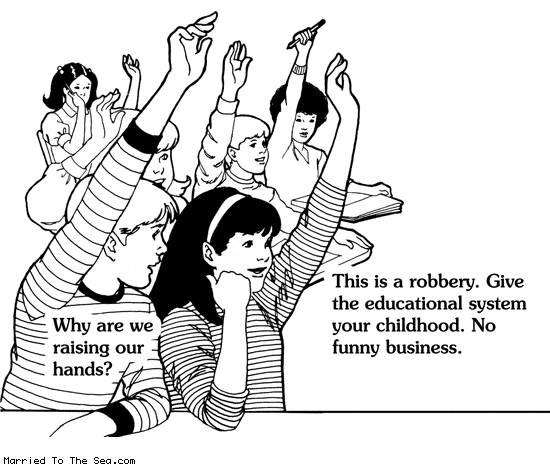
Well, this is serendipitous.
Monday, September 12, 2011


Poetry Post-9/11
Hello neglecterinos!
If all goes well, reviews from me will start popping up at the Contemporary Poetry Review any day now.
I thought I would need to shutter the blog in respect of their publishing schedule and a new, grueling pace of work.
Since, however, they publish on a traditional-publishing model, I think it's best I get back to the blog for some unadulterated poetry commentary.
First I think we might as well start off acknowledging our new calendar. Conveniently we have the 9/11 attacks to encourage us to look at "the new millennium" as an actual turning point and not simply a calendrical one.
We live in a world of blogs, smartphones, viral videos, and a bunch of other junk that it's pointless to say and makes me look like a bit of a fuddy-duddy.
I'm not, however. But most poetry publishers are.
A search on Amazon tells me that the most popular books in poetry are all e-book editions. Even the books that are popular in hard-copy have audio and e-books available.
But those are all published by "the big guys" and the problem with "big guy" publishing is that the poems are generally tepid at best and more like lukewarm sugar-coated kitty litter in practice.
What of the small presses (even the big ones)?
A search on Red Hen Press gives me lots of books to buy but none to download, either to read or listen to.
I don't see any electronic versions on Graywolf Press's site either.
The micro-presses I'm most familiar with don't offer such things.
Now, I would love to be wrong.
I would like, you my readers, to say "this! This small press publishes e-books and audio-books along with their traditional books."
Because if I can't find that then we have witnessed another gaping hole in the quest to deliver great poetry to the people (and specifically the American people): there's no outlet above the "mere blogosphere" yet below the giant publishing houses to deliver quality work.
Why?
Recording studios do this all the time--every band with a recording has a way to buy that music electronically.
Why don't we do this with poetry?
In a world where skyscrapers can be knocked out of the sky, why are small presses still holding on to hard-copy books?
Anyway, that's what's on my mind this morning.
I've changed this blog a dozen times since I started writing. We'll see where this new iteration takes us.
Sunday, May 1, 2011
My Only Thoughts on the Subject
Are from another's pen:
Many that live deserve death. And some die that deserve life. Can you give it to them? Then be not too eager to deal out death in the name of justice, fearing for your own safety. Even the wise cannot see all ends.
Thursday, February 17, 2011
Palmer on Poetry: 197.3 December 2010
December's copy of Poetry has been sitting with a Cross been stabbed through its unfinished pages since my last review post. This has been partially because of the business of the season (Thanksgiving-through-New Year's Day is a festive blur in the Palmer house). But I have two other, mostly unread, copies of the magazine staring at me and AWP glancing over its back at me from two weeks' time. I'd really rather have as many reviews as possible done by then (especially as I'm now flying and not taking the train).
The December issue is called "The Q&A Issue" and covers a scant Baker's Dozen poets (though really that number is reduced as three of the poets are dead Italians here translated by Geoffrey Brock). According to the Poetry Foundation website there was another Q&A issue in April of 2010 (prior to my subscription starting). I hope these don't become a trend but judging from some of the letters-to-the-editor in the February issue, they just might. For my part, I found the majority of the question-and-answer sessions to be extraneous at best. Indeed, they're the reason it took me so long to get through the issue as most of the readings were a slog.
Poetry
Volume 197
Issue 3
December, 2010
Michael Robbins
Paula Bohince
Tom Pickard
John Tranter
Charles Baxter
Jane Hirshfield
Clemente Rebora
Giovanni Pascoli
Attilio Bertolucci
David Roderick
Linda Gregerson
Vijah Seshadri
Sina Queyras
Belle Randall
There are no gravestone endsheets in this issue.
Apologies for the earlier post. Blogger was having problems today. That was a draft. I don't have much to say about this issue, but I want to get to January and February.
Friday, February 4, 2011
A Review: Terminal Diagrams by Garrick Davis
Terminal Diagrams
by Garrick Davis
2010, Swallow Press, $13.56 ($5 ebook)
It is possible that in Terminal Diagrams we have been given a rare bird--a collection of poems that seems at once Christian and reactionary (as in rejecting this modern age). I believe that Don Colacho would be fond of much of this work.
This is not to say the collection is flawless--indeed, like the sinners that it drinks with it has flaws and, I would argue, is aware of them.
One is alerted to the "different" nature of this book from the very cover--we have Mr. Davis and a lovely lady coming out of a gleaming Maserati--made more gleaming by the book's silvered cover. It is telling that a collection of poems that as objects on the page look unflashy and full of "quietude" that the cover and content should be so unashamedly forceful.
The first poem is the book's epigram, in which we find the terms "mechanical," "pandaemonium," and "sotto-voce." Unlike many, this is a useful clue to the contents of the poems within--wefind in the collection a syzygy of the temporal, the canonical, and the classical. Though Davis's poems engage Eliot more than Milton, the Revelation imagery that presents itself in the volume's final poems stretch his depth of influence to a refreshing pandaemonium.
In the poem's second epigram we are told by T.E. Hulme about "the relation to machinery" that "vital art" must reconcile in this modern age. Though this epigram serves the first poems well, by the end of the volume it clear on which side of modernity this book's bread is buttered.
The opening poem "Ultramodern" gives us in the first two stanzas a hint of what I find most expertly done by Davis, that of the apt word, phrase, or juxtaposition. Even in a poem that I might otherwise find middling, there is a gem so perfect that it requires a reevaluation of the text surrounding it.
In "Ultramodern," people are "paid/to sit and wait for someone to speak" but they only listen "when the clock says they can leave." If you've not experienced this, simply call an 800 number and try to get help--either from human or machine. The poem continues in its description of our modern maladies, from lights that "switch night to utter asphalt" and "tabloid lines" that "plead/This Is Not A Hoax!"
Indeed it is not. I would like to add that the poem ends with what I would call one of Davis's flaws: "Who shall stand in the wrath to come?" Here Davis chooses shall over what, by all modern and alliterative rights, should be "will." It feels as if Davis here is choosing propriety over poetry--but it may be simply choosing the past over the present; either way it's a note too far.
"New Bohemia" is one of many poems in which Davis seems to be both channeling Eliot "at the absinthe-hour, I scribble these lines" and, inexplicably, me "a black-leather dandy of nightclubbing" (though my unpublished work--so unless Mr. Davis is a mind reader, I suppose we have just tugged on the same invisible literary lines). With its final "orphan of the oracle," Davis taps in to the "fatherless sons" vibe so present to a post-Fight Club world.
"Lila" and "At the Underground Club" are solid works that stolidly tell of the process of aging without achievement; again the pre-Ash Wednesday Eliot is never far from the surface in these poems.
"Metal Machine Music," with its title cribbed from Lou Reed, gives us "the pre-millennial tension" of "blips and beeps/instead of notes" and introduces us to the important symbol of "muzak," here "a muzak-of-the-spheres." Muzak, that elevator symphonist, runs throughout Terminal Diagrams, reminding us of the artlessness of modern art.
"Aubade" is a bit of a misstep, with its "flesh deflating" too very. I did find the end of the poem, the "piece of its mirror/in which I can't see anyone alive" to fit well with the book as a whole, but in the collection it seems out of place.
"Techno" and "Pastoral" are workable poems, with the possible criticism of "or what is left of it" being redundant--again the endings, especially escaping "the horizon's/fine thread of telephone lines" connect the poems to the book. "Unrestricted Development" is one of Terminal Diagram's many short poems, all of which are pleasurable and many profound.
"Cost-Benefit Analysis" and "Disaster Report" are two excellent pieces that from cubicles and the evening news put fire to the meaning and value of modernity--it is in these poems that the "mass market appeal" that seems so inevitable in the prior works is first challenged.
"Drive Song" is one of the first poems that I delight in, though it is a despairing delight as the poem tells us of the "choked tears in driveways" of those "charged and mortgaged to the marrow."
"The Art of Drifting Through Los Angeles" fully plants Davis's work in Eliot's "Unreal City"; though Eliot would never have chose, in 1922, LA, it seems clear that the city, in Davis's view, has built itself upon "The Waste Land." Speaking of waste, it is in "On Passing the San Onofre Nuclear Power Plant" that Terminal Diagrams begins to embrace its symbolic structure, adding "Moloch" to the mix. The biblical allusions arrive in the second half of the collection, and modernity becomes place, and finally overshadowed, in the context of the past.
This symbolic structure continues in "Christmas Shopping at Horton Plaza" where the season, stripped of meaning, is rebuilt "by thin ladies" "as acolytes." The poem has my favorite description of Davis's commercial world, which I will simply quote:
The eye of God peers from its dollar,
On each indulgence bought at the mall.
As I stroll and sing an ad-jingle
a plane, towing brand-names, blocks the sun.
Next follow "Zone" and "Revelation," two of the collection's stronger works. It is in Zone, which we are told is "after Apollinaire," that Eliot rears his head (or shows his own influences) and that we get what is, perhaps, the collection's clearest line:
I lived like a fool and wasted my life.
"Revelation" is simply spot-on from start to finish. In it we are "entertained to the end" by the devil in the cables. This sentiment is continued in "Deus Ex Machina," wherein "time is kept by launch code and fuse" and "science is a liturgy," in "www.prepare4y2k.com" where we are "awaiting/a glitch in the millennium," and "While Reading the Revelation of St. John the Divine, I Turn On the Television," where "each day the world holds by a hangnail."
This despair is brought to its conclusion by the collection's eponymous poem. In "Terminal Diagrams," "one cannot buy the letters," and "history now belongs to the vanquished." Here Davis demonstrates clearly the inescapable dangers of this machinery Hulme warned us of--"box-office receipts form our Bulfinch" and "we have old episodes for classics."
"Gone" are "beautiful manners," "tradition," and "foundations." The poem calls for "some Jonah" but is convinced that no prophet is coming or would ever again be heard.
The poem, and thus the collection, ends with two of the most delightfully enigmatic lines I have read. They work with both the poem and the collection as a whole:
I see the end is near, the flashing signals,
As that last man, crossing the Rubicon.
I have in my notes three questions, none of which is it possible to answer--and that may be the value of the entire work that Davis has presented us with:
is this poem finally embracing the loss of all that is beautiful? That is, does the collection end on a 1984 note? Do we love modernity? That is, is this last man crossing the Rubicon simply aware that Caesar has already crossed (and Sulla and the Gracchae before him) and that there is no going back?
Is it simply the acceptance of the inevitability of the conflict between past and present and the rugged willingness to join that conflict?
Or, finally, is it one more soul climbing Parnassus? What was Caesar fighting--to change or preserve?
As a classicist who cut my poetic teeth on modernism, I must say I dearly love this collection. It does what all good poetry--what art--must do--it presents the world in new ways and, as poetry, translates the unspoken words bound upon our modern tongue.
Wednesday, February 2, 2011
AWP-Bound!
Hello all,
I'm headed to DC this afternoon for my 3rd trip to AWP.
Come visit me Saturday at the UNOPress table.
I will do my best during downtime (does that exist) to finish these gall-darned reviews I have.
See you in the cold!
Friday, January 7, 2011
Pay for your books!
My friend Adam Deutsch of Cooper Dillon Books has a post on selling books of poetry.
My favorite part(s):
Shouldn't the sale of books keep their books in print?
and from Gandhi:
Institutions maintained on permanent funds are often found to ignore public opinion, and are frequently responsible for acts contrary to it.
Happy reading!
Subscribe to:
Posts (Atom)

 Posts
Posts