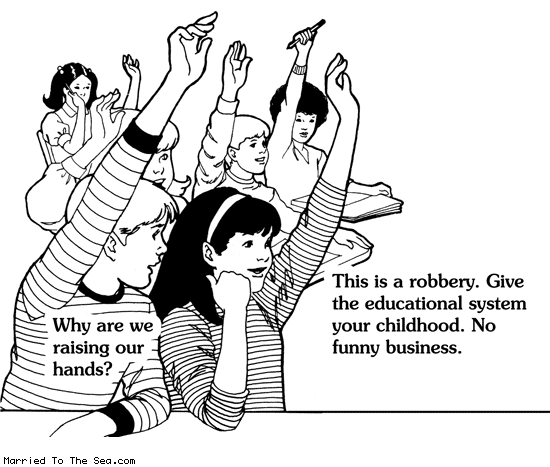
We know my unshrouded contempt for the claim that 2d art is poetry.
But why?
Here might be an analogue to help:
A painter paints, but then realizes that people, when they are not looking at his paintings, are talking about his paintings.
He says to himself "ah, it is not my painting that people love, it is the experience of my painting they love -- especially the talking about it."
So in order to help people talk about his paintings, he begins to incorporate words on his canvasses. He also starts to include larger and larger explanation placards to give his audience talking points.
One day, he doesn't produce a painting at all, but a large 4x3 white canvas with 16-point type describing a painting that isn't there. Eureka! He has given his fans what they truly want!
Not the painting, not the looking at the painting -- but the shared experience of having thought about looking at the painting -- the water-cooler chat, as it were.
"But," some child says, "you haven't painted anything. You aren't a painter anymore -- this isn't a painting."
"Oh, the ignorance of youth" thinks the painter. "Of course I am a painter, I have just found the essence of painting and given it to my audience."
In all of this,
the "painter" thinks he knows best.
In all of this,
the "painter" ignores the nature of his art.
Painting is eye-candy. As long as colors and shapes are on a canvas, we will look at them. We may talk about them to our friends -- to those who can't see the colors in front of them, but the experience, the purpose of a painting is to see it. No description can do a painting justice.
In the same way,
poetry is ear-candy. We will listen if it sounds good. When we are unable to listen, we may "listen in our heads" by reading the poem -- but the experience of the poem is aural, not visual. When we move away from the aural, we move away from poetry.
Thursday, December 18, 2008
Speech & Poetry


Thursday, December 11, 2008
We need a new Milton
(thanks to Silliman for the link)
from the article:
"How did we get to the position, in our cultural history, where our poets are so bad? Milton supplies us with some of the answer in his great poem Lycidas, the lament for a lost Cambridge contemporary who will never fulfil his promise.
First, the lost poet is described as "a learned Friend". As Yeats and Eliot's poetry show, becoming a poet is a hard apprenticeship. Poets must steep themselves in the old stories, the old mythologies, the old culture.
Poets provide a society with its most articulate memories. Homer created for the Greeks, the collective memory of the Trojan war, just as the Beowulf poet kept alive the glimmering memories of the heroic North just as it was about to vanish."
Looks like I'm not the only crazy in the world.
Wednesday, December 10, 2008
Your narrative poetry?
We already know that narrative poetry is superior to lyric poetry.
I called for the writing of narrative poetry about half a year ago.
Does anyone have any to share?
Look for some from me on 1/19/9 or 19/1/9, you know, depending on your time/date preference.
Pest,
M
Tuesday, December 9, 2008
Because College Football is Awesome
That's right.
Go friggin Gators.
Florida is going to beat the pee out of Oklahoma.
OU scores 2.2 times as many points as its opponents.
UF scores 3.4 times as many.
OU has allowed 319 points by its opponents.
UF has allowed 167.
So UF outscores OU by 120%, and allows half as many points.
Oh, and the average defense rankings of the teams OU has played is in the 70s. Florida's defense is ranked 9th. And they're pretty awesome against the pass.
I smell a blowout.
In an average game, Florida scores six touchdowns (44 points) and OU scores seven-and-a-half (54).
Florida allows just two (13) and OU allows three-and-a-half (25).
I'm thinking OU gets about half of its regular score (54 ppg) and Florida gets about 125% of its regular score (44 ppg):
Florida: 56
Oklahoma: 28
Go Gators!
Monday, December 8, 2008
True Believers
from Ender in Exile:
"True believers in a cause often behave in self-defeating ways because they expect other people to see the rightness of their cause if they just state it clearly enough. As a result, they tip their hand in every game and can't understand why everyone gangs up against them."
Hm.
Tuesday, November 25, 2008
Give thinks
In about a month, the new site will be up. I'm still trying to figure out the best way to work everything (if anyone knows how to use drupal, I am ready to be schooled) but at the very least I'll just steal some blog architecture and build the new magazine that way.
So I haven't read much poetry lately -- other than the poems I've been forced to teach my students (really, who makes these awful "literature" workbooks?), but I find myself wondering how to construct my next poetic project.
I'm planning to write a long narrative poem (big surprise there) about Korean War POWs. The problem, the one I (and Milton) always find in English poetry is how to construct the thing. The last lengthy narrative I wrote was in a bluesy sort of Beowulf-like meter that was far more accentual than accentual-syllabic. It was surely fun, and I've used it in my stalled fairy-tale project (retelling a dozen fairy tales without magic), but I'm thinking the Korean pieces will be shorter (the previous poem is 2,000 ish lines long and divided into 6 sections and the fairly tales are about 400 lines each) by an order of magnitude (about 30-40 lines). With something this short, I'm tempted to use rhyme as well
but
rhyme is so dangerous in American poetry. It can be gotten away with in song, because all songs are a little bit silly (or playful? better term?). I'd like to embrace the ludic in these lines but, geez, I'm talking about brainwashing and the collapse of humanity and all -- heavy -- and I'm wondering if the rhyme will trivialize it.
So I'm debating a few things -- the first is to look at some popular lyrics of the late 1940s and very early 1950s (you know, pre-rock) and play with the way they rhymed, this often involves a lot of internal rhyme and slant rhyme (assonance?), which might be awfully fun to play with.
Another is to look at the poetry that would have likely influenced the narrator. I'm thinking ww1 war poetry and the early moderns -- but I don't want to slip into the solipsistic narcissism of the moderns -- been there, done that, have 4 or 5 dozen impossible poems from it.
The final is just to play with rhymes -- nothing as insane as amphisbaenic rhyme (one sonnet in that was more than enough) -- like again slant/near/half rhyme and internal rhyme -- and rhymes in weird places. A little prep work with writing Canzones has given me a feel for internal rhyme -- but a great danger of rhyme is that it can speed things up.
So, readers, from my daily Canadian to folks as far as Indonesia, what are your favorite sorts and examples of imperfect rhyme? How do you puzzle out the difficulty of rhyme in English?
What are your favorite songs from 1940-1953?
Wednesday, November 12, 2008
liquidity levity
Why have a blog if it can't host silliness every once in a while?
NEW edits as of Dismember 9th:
Bye bye, Dow!
Bye bye, GDP,
Hello, insolvency,
the economy's gonna die.
Bye bye, my money, goodbye.
There goes my money
with a guy named Wu.
He sure looks happy,
I sure am blue.
It was my money
but it's not now
'cause Congress gave it
to Hu Jintao.
Bye bye, Dow!
Bye bye, GDP!
Hello, insolvency,
the economy's gonna die.
Bye bye, my money, bye bye.
I'ma through with finance,
I'ma through with banks.
I'ma through with bailouts,
I'ma through with Hank.
You cannot tell me
inflationary cash
is gonna save our
dumb bankrupt ass.
Bye bye, Dow!
Bye bye, GDP!
Hello, insolvency,
the economy's gonna die.
Bye bye, my money, bye bye.

 Posts
Posts